


I am not a lawyer and this is not legal advice. I used AI tools to help research publicly available federal law, then verified citations against primary sources. Before taking any action based on what you read here, consult a licensed immigration attorney. This post is independent public commentary and does not reflect or constitute any part of my paid coaching programs.
A founder I coach came to me with a problem. He’d talked to three immigration lawyers about filing a concurrent H1B through his own company. All three told him the same thing: you need a board of directors, complex bylaws, and a governance structure that proves someone else controls the company. Otherwise USCIS won’t approve it.
All three were quoting pre-2025 law.
In January 2025, a rule change made that entire requirement obsolete. No board needed. 100% ownership allowed. Cheaper path. Simpler filing. The H1B Modernization Rule killed the old employer-employee control test. But these three licensed attorneys were still building around a rule that no longer existed.
He was about to spend months and real money setting up a governance structure for nothing. One hour of reading the Federal Register would have caught it.
Here’s the thing. You can’t audit what you don’t understand. The credential tells you they passed the bar. It doesn’t tell you they read this year’s Federal Register. Immigration law moves fast. New rules, new guidance, policy shifts every year. The attorney who handled 500 cases in 2022 isn’t lying to you. They’re reaching for the answer they already know.
You have to know enough to interview them.
So I did what apparently nobody does anymore. I read the law.
Claude helped me surface the relevant clauses. Every citation below links to the original source. Verify it yourself.
Not a blog post about the law. The actual United States Code. The CFR. The USCIS Policy Manual. Federal court decisions.
Here’s what I found.
What the Law Actually Says
The regulation that governs what you can do on H1B is 8 CFR 274a.12(b)(9). It says:
“An alien in this status may be employed only by the petitioner through whom the status was obtained.”
Read that again. It restricts employment. Not “all activities.” Not “anything business-related.” Employment.
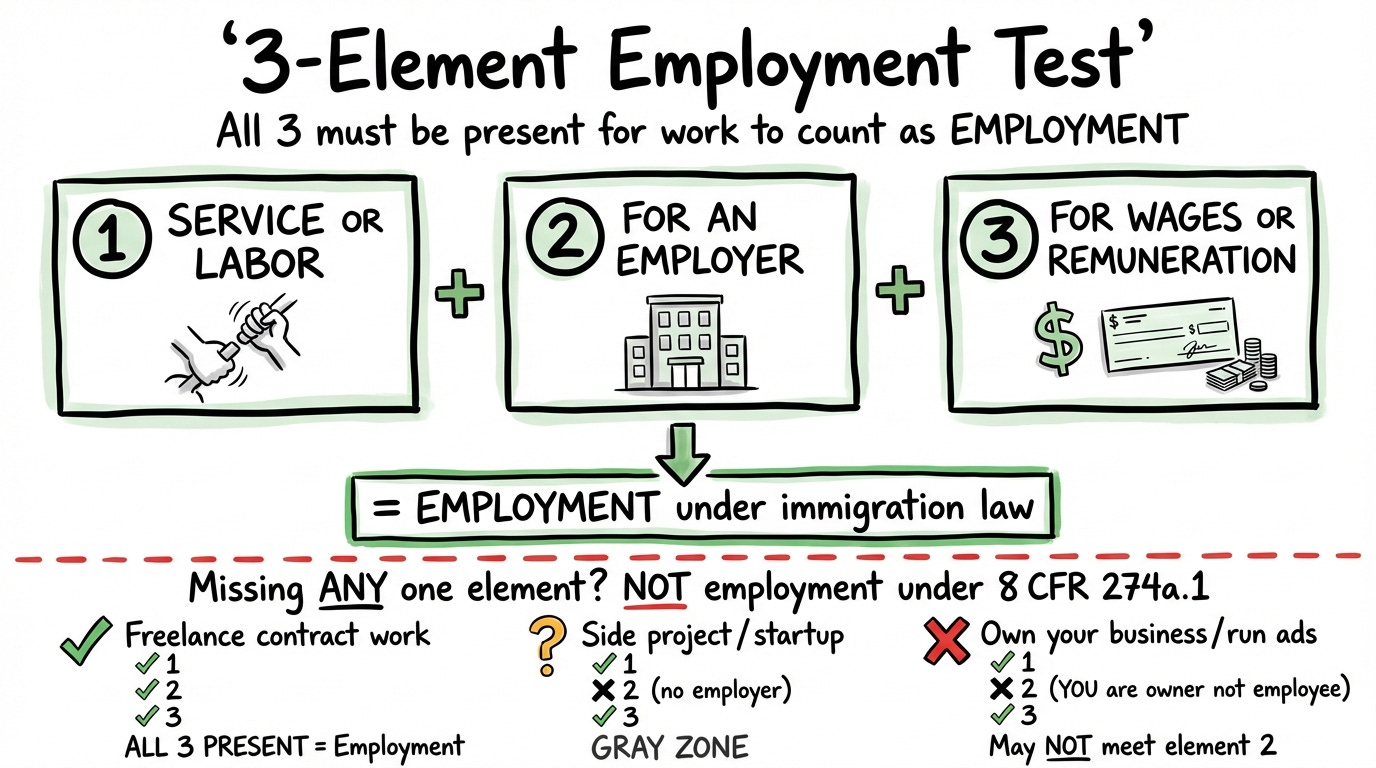
And what is “employment”? The regulation defines it at 8 CFR 274a.1:
“Any service or labor performed by an employee for an employer within the United States... for wages or other remuneration.”
Three things must exist for something to be employment:
Service or labor
For an employer
For wages or other remuneration
If any of those three is missing, the regulatory definition of employment is not met.
What the Law Does NOT Say
There is no statute, no regulation, and no USCIS policy manual section that says:
You can’t own an LLC
You can’t own a restaurant
You can’t have a side project
You can’t spend your own money on ads
You can’t build things outside your 9-5
These prohibitions don’t exist in the law. They exist on immigration lawyer blogs. There is a difference.
The legal framework is built around regulating employment relationships. Employer hires employee. Employee performs labor. Employee receives wages. That’s what the law cares about.
Activities that don’t create an employment relationship? The law is silent.
The Case Everyone Cites (And Gets Wrong)
Every lawyer blog about this topic cites Wettasinghe v. INS from 1983. A guy bought ice cream trucks, stocked them daily, occasionally drove them, and collected rental payments plus a percentage of sales.
What the blogs don’t tell you: Wettasinghe was on an F-1 student visa. Not H1B.
The court’s reasoning was that F-1 restrictions exist “to insure that those who seek entry into the country to pursue educational opportunities in fact do so full time.” The purpose of F-1 restrictions is to ensure full-time study.
H1B is a completely different framework. You’re already authorized to work. The question isn’t whether you can work at all. It’s whether a specific activity constitutes unauthorized employment with someone other than your petitioner.
Using an F-1 case to interpret H1B restrictions is like using traffic law to argue about property rights. Same legal system, different body of law.
There are other administrative decisions (BIA rulings, AAO non-precedent decisions) that touch on self-employment in immigration contexts. The legal landscape is more complex than one inapplicable F-1 case. This is exactly why having an attorney who’s current matters. But Wettasinghe is not the H1B precedent the internet treats it as.
The December 2024 Rule That Changed Everything
In December 2024, USCIS published a final rule that most people haven’t read. It’s in the Federal Register (effective January 17, 2025) and it explicitly addresses H1B holders who own businesses.
The new provisions under 8 CFR 214.2(h), as amended by the December 2024 Modernization Rule, say beneficiary-owners can perform:
“Non-specialty occupation duties that are directly related to owning and directing your company, along with some incidental duties.”
What’s explicitly permitted:
Signing leases
Finding investors
Negotiating contracts
Developing business plans
Engaging with suppliers and stakeholders
Talent acquisition
The US government looked at H1B holders who own businesses and said: we know owning a business involves activities beyond your specialty occupation. That’s fine.
The catch: beneficiary-owner petitions have an 18-month validity cap on the initial petition and first extension. That’s not 3 years like standard H1B. For a founder planning a timeline around green card processing or company milestones, the 18-month increment is a real operational constraint. Factor it into your planning.
This is not my interpretation. This is the text of the regulation, published in the Federal Register, effective January 17, 2025.
Important scope note: The beneficiary-owner provisions apply specifically to H1B holders who petitioned through their own company. If your H1B is sponsored by an employer, these provisions do not change your side project analysis. They govern a different relationship: you as both owner and H1B beneficiary of the same petitioning entity.
The Real Risk Map
So what’s actually safe and what’s actually risky? As of early 2026:
You can do this. The law is clear:
Own an LLC or C-Corp
Get an EIN, open a business bank account
Write a business plan
Hire lawyers and accountants
Make passive investments (stocks, real estate, crypto)
Have someone else operate your business entirely
Attend board meetings as an owner
Do all the “non-specialty occupation duties” the 2024 rule allows
This is the gray zone. The law is silent:
Running ads yourself (spending money, not receiving it)
Building a side project or app
Customer interviews and “market research”
Hobby coding on your own time
These aren’t prohibited by any statute or regulation. But they’re also not explicitly blessed. The risk here isn’t legal certainty. It’s characterization. If USCIS looks at your activities and decides they constitute “employment,” you have a problem.
The practical risk for someone spending their own money on market validation with no revenue is low. But low risk and zero risk are different things. And “no wages” is not a settled legal shield. BIA decisions have found that future economic benefit, audience building, and equity accumulation can constitute remuneration even without a salary. Know the line.
There is also a separate legal concept the employment analysis does not cover: failure to maintain nonimmigrant status under INA 237(a)(1)(C)(i). You can violate your H1B status through activities USCIS deems inconsistent with your classification, even if those activities don’t technically qualify as “employment” under 8 CFR 274a.1. The employment test is not the only test. Keep that in mind.
Don’t do this. The law is clear:
Receiving wages or revenue from a business you operate on H1B (without a filed petition)
Working for any employer without a filed H1B petition
Having an employment relationship (service + employer + wages) with someone other than your petitioner
Why Lawyer Blogs Get This Wrong
Immigration lawyers are conservative by design. Their job is to keep you out of trouble. If they tell you “everything is fine” and something goes wrong, they’re liable.
So they default to “don’t do anything.” They tell you running ads is unauthorized employment. They tell you having a side project is illegal.
I’m not saying ignore legal advice. I’m saying read the source material yourself. The statute is public. The CFR is searchable at ecfr.gov. The USCIS Policy Manual is at uscis.gov/policy-manual. Court decisions are on Google Scholar.
You’re smart enough to read a regulation. You’re on H1B, which means you have at least a bachelor’s degree and work in a specialty occupation. Act like it.
The Bottom Line
The law restricts employment. Employment requires service, an employer, and wages. Activities that don’t meet all three elements of that definition exist in a space the regulations don’t explicitly reach.
This doesn’t mean “do whatever you want.” It means the internet’s version of H1B restrictions is significantly more conservative than what the actual statute and regulations say. The fear is overblown. The risk is real but nuanced.
Read the law. Know the line. Then build.
I walked this path myself. Self-sponsored my H1B, built a SaaS company, went through the compliance maze. Now I coach other H1B founders through it.
Every week I answer questions like this in our 1,000+ member H1B founder community. If you’re on H1B and thinking about starting something, we’re here. WhatsApp Community | Newsletter
Tomorrow at noon ET, I’m hosting the first H1B Founders Live with a founder who self-sponsored his H1B through his own company. Join us.
Disclaimer: I am not a lawyer. This is not legal advice. This is me reading publicly available federal law and sharing what I found. Your situation is unique. Consult an immigration attorney for advice specific to your case. But maybe read the statute yourself first. And when you meet with your lawyer, ask them specifically about the December 2024 Modernization Rule. That question alone tells you how current they are.
Sources (Primary Only)
8 USC 1101(a)(15)(H)(i)(b) — The H1B statute
8 CFR 274a.12(b)(9) — “Employed only by the petitioner”
8 CFR 274a.1 — Definition of “employment”
USCIS Policy Manual Vol. 7, Part B, Ch. 6 — Unauthorized Employment
Wettasinghe v. INS, 702 F.2d 641 (6th Cir. 1983) — The ice cream truck case (F-1, not H1B)
December 2024 H-1B Final Rule — Beneficiary-owner provisions, effective January 17, 2025
8 CFR 214.2(h) — H1B regulations